Tree Trimming in Fayetteville, AR
Clearance from roofs and drives, deadwood out of the canopy, and structural pruning that leaves the tree better than we found it.
(479) 317-8391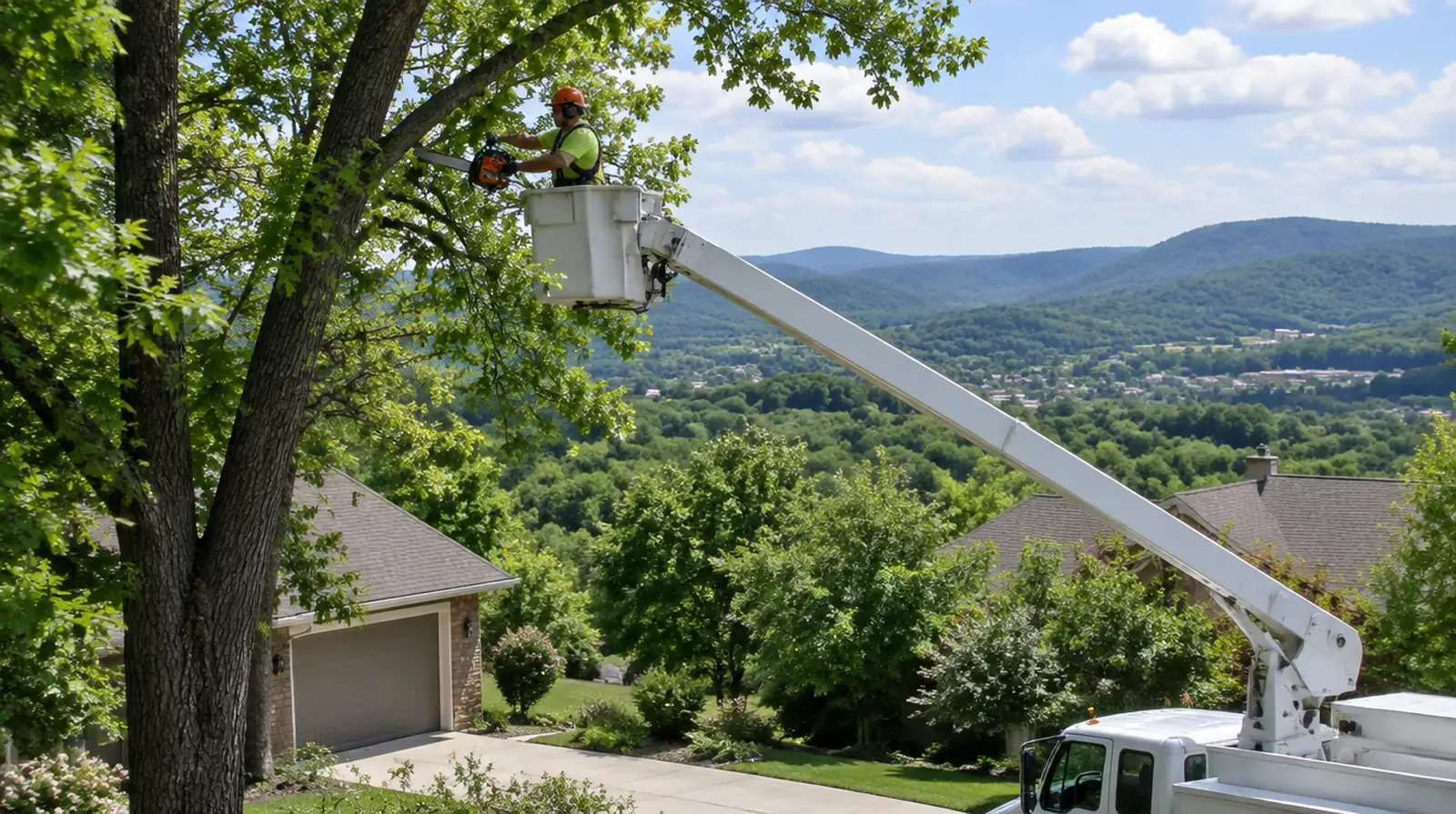
Pruning is where most tree damage in this town comes from
More Fayetteville trees are ruined by bad pruning than by storms. The usual culprit is topping, where the crown is cut back to stubs to make a tree smaller. It works for about two seasons. Then the tree responds to losing its canopy by pushing out dense clusters of fast, weakly attached shoots from the cut ends, and five years later you have a taller tree with worse structure than the one you started with, plus large open wounds that never sealed.
We do not top trees. What we do instead depends on what you are actually trying to solve, and there is usually a specific cut that solves it.
Crown cleaning
Removing the dead, dying and broken limbs out of the canopy. This is the single highest-value pruning most mature trees get. Dead wood in a big oak is what comes through a windshield in the first strong gust of spring, and taking it out changes nothing about how the tree looks from the street.
Crown thinning
Selectively removing interior branches so wind moves through the canopy instead of pushing against it like a sail. Done properly it reduces the load on the trunk in a storm and lets light down to the lawn underneath. Done badly it strips the interior and leaves all the weight at the ends of the limbs, which is worse than not touching it.
Crown raising
Taking the lowest limbs off to get clearance over a driveway, walkway, roofline or line of sight. This is most of what people actually want when they call about trimming.
Structural pruning on young trees
The cheapest tree work you will ever buy. Correcting a competing leader or a bad branch angle on a fifteen-foot tree takes twenty minutes and prevents the split trunk that would cost you a whole tree coming out in thirty years.
Limbs on the roof are not a cosmetic issue. Branches resting on shingles wear through the granules every time the wind moves them, and they hand squirrels and roof rats a bridge into your soffit. Eight to ten feet of clearance is the target.
When to prune
Late winter, while the tree is dormant and before the spring push, is ideal for most hardwoods here. The structure is visible with the leaves off and the tree seals cuts quickly once it wakes up.
Oaks are the exception worth knowing about. Pruning oaks during the growing season creates fresh wounds that attract the beetles carrying oak wilt, so we avoid non-urgent oak pruning from roughly April through July. If you are seeing decline in an oak already, that is a different conversation, and our tree health page covers it.
Dead, hanging or hazardous limbs get removed whenever we find them. Season does not apply to something about to fall.
What it costs
Pruning is priced by the tree, based on size, how much is coming out, and how much of it has to be lowered on ropes rather than dropped. Clearing deadwood from one large oak over a driveway is a different job from thinning three ornamentals in an open front yard. We come look and give you a written number.
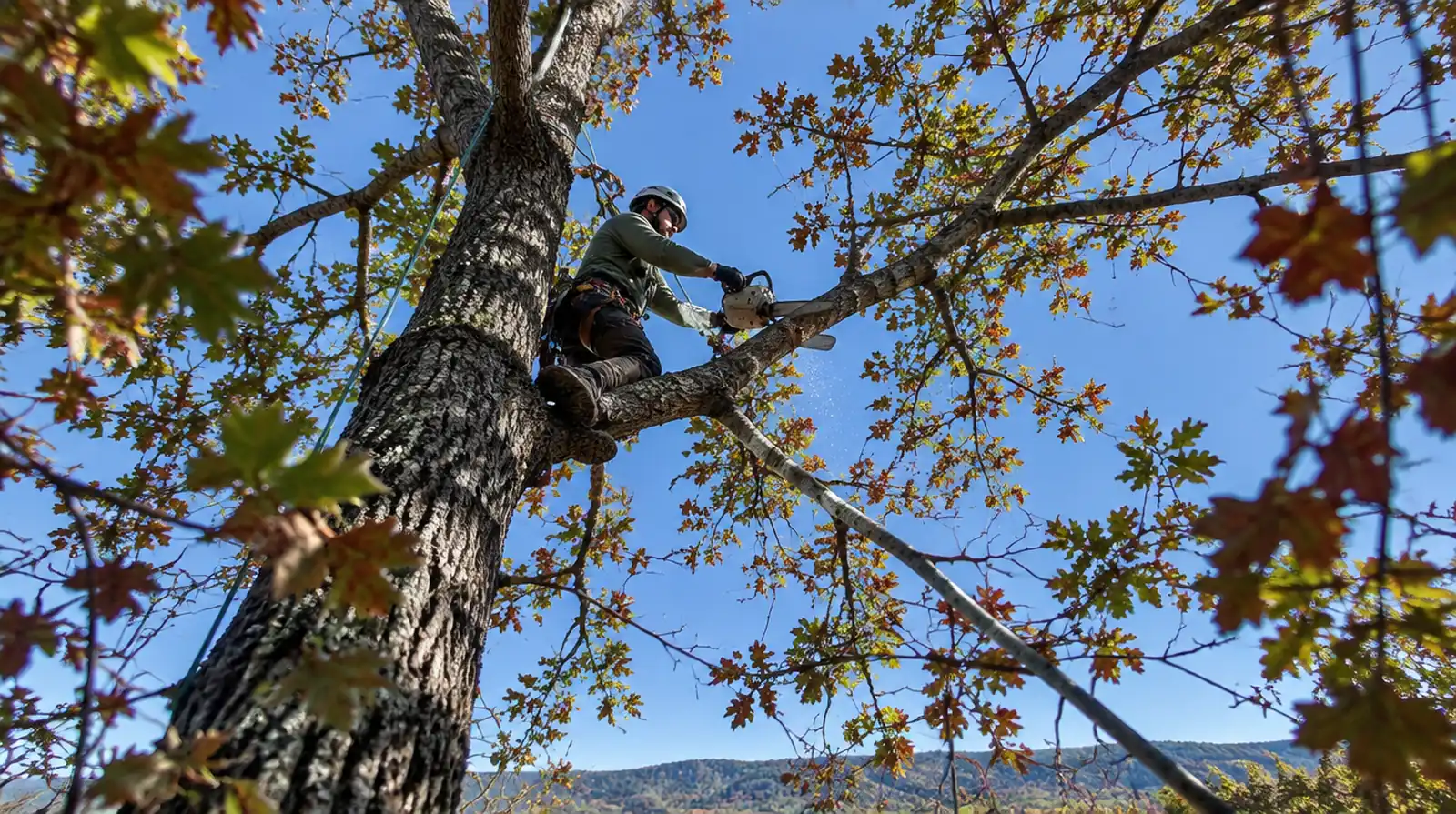
What a good pruning job leaves behind
You should be able to stand in the yard after we leave and see a tree that looks like itself, only lighter and cleaner. The outline should look natural, there should be no stubs left sticking out, and the interior should not be stripped bare with all the foliage left on the branch ends. That last pattern, sometimes called lion-tailing, puts the weight at the tips where it does the most harm in a wind storm.
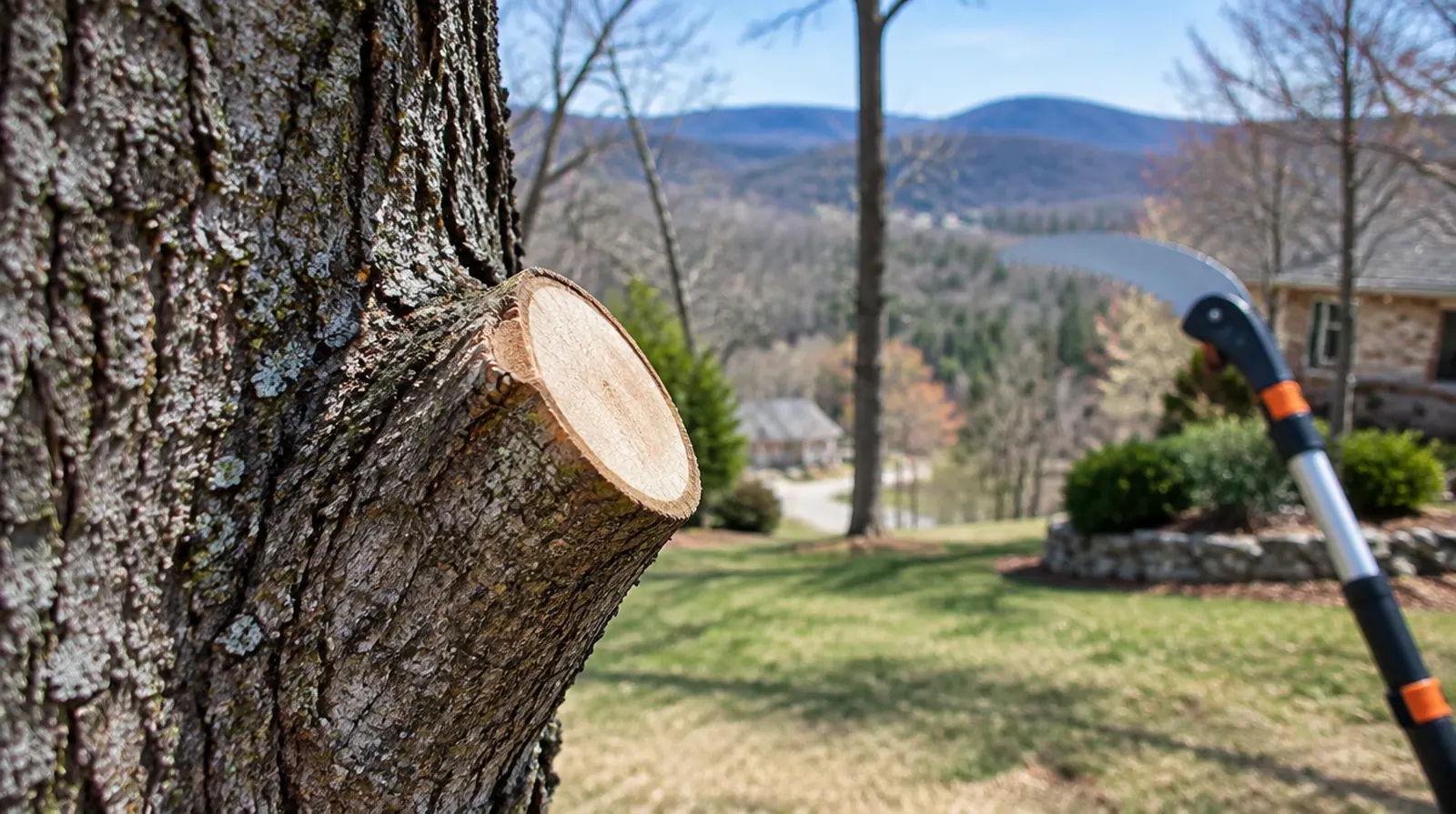
Every cut is made just outside the branch collar, the slightly swollen ring where a limb joins the trunk. Cutting there lets the tree seal the wound on its own. Flush cuts and long stubs both slow that process and invite decay. We do not use climbing spikes on trees we are pruning, because every spike hole is a wound in a tree that is supposed to keep living.
Clearance work around homes and drives
A lot of our trimming calls are about clearance: limbs rubbing the roof, branches hanging low over a driveway, or growth crowding the service drop to the house. Roof clearance keeps leaves out of gutters and keeps limbs from scraping shingles in the wind. Driveway clearance matters for delivery trucks and for any heavy equipment you may need later. Lines owned by the utility are its responsibility, and we will tell you when a branch is in that category.
If a split or weak fork shows up while we are in the canopy, we will point it out and talk about support options or removal.
On younger trees in new subdivisions, a little structural pruning every few years does more good than anything else. Choosing one strong central leader early prevents the weak forks that cause trouble decades later, when the tree is too big to correct.
Get a trimming quote
Tell us what you're dealing with and we'll get back to you with a no-obligation quote. Most estimates are free and on-site.