Hazardous Tree Removal in Fayetteville, AR
Dead, cracked, hollow and leaning trees taken down with a plan built around how they could fail.
(479) 317-8391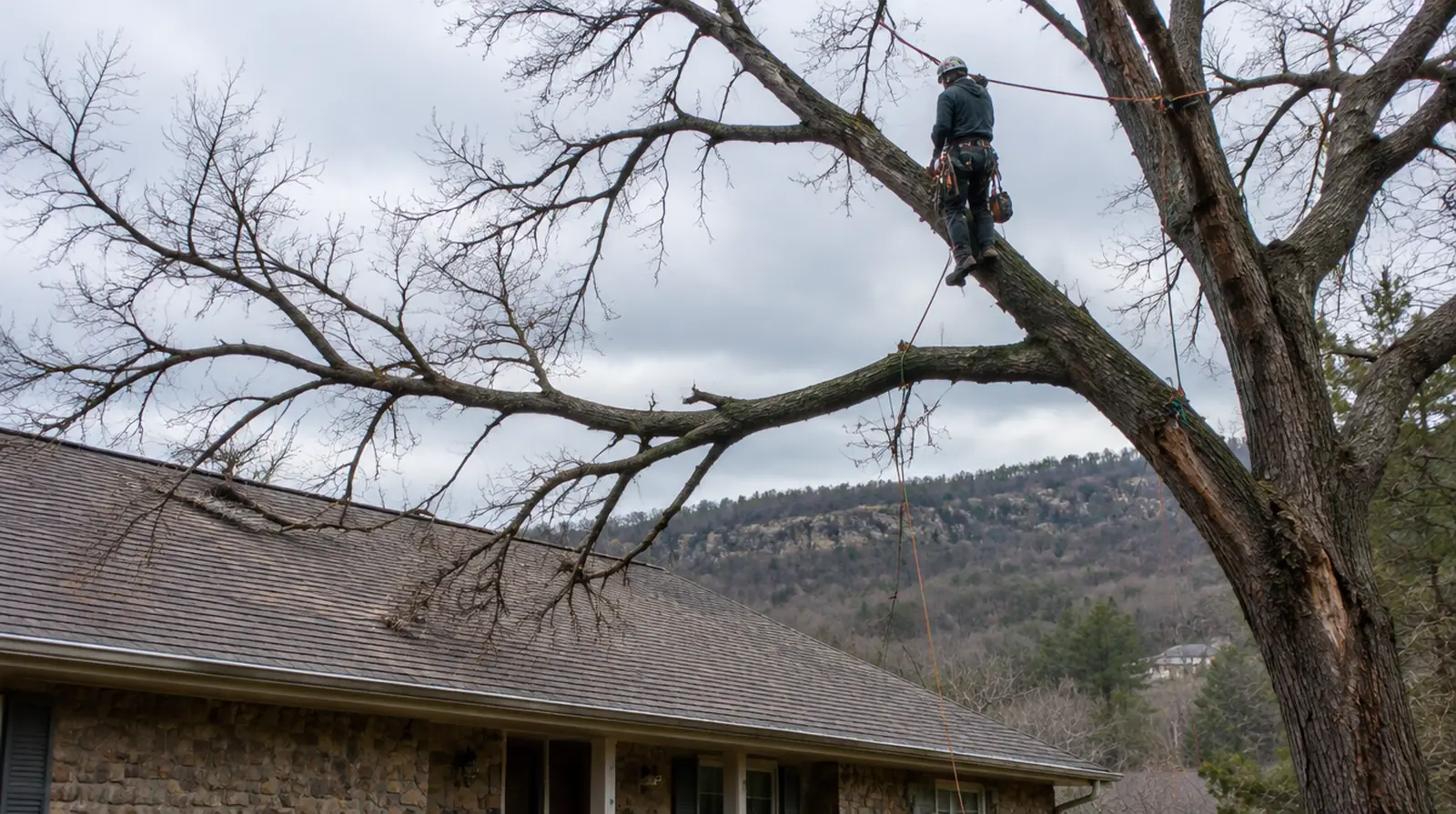
Why a hazardous tree is a different job
A healthy tree is predictable. The wood bends before it breaks, limbs hold the weight of a rope and a climber, and a cut behaves the way it was planned. A dead or decaying tree does none of that reliably. Dry limbs snap instead of bending. A hollow trunk can collapse when a notch is cut into it. A tree leaning on a cracked root plate can shift as soon as weight comes off one side.
That is why we treat hazardous trees as their own category. The equipment is the same as a normal tree removal, but the planning is different. Before anyone climbs, we decide whether the tree can be climbed at all, or whether it has to be worked from a lift or taken down from the ground. Some trees are too far gone to put a person in.
Signs a tree may be hazardous
- Large dead limbs, or a crown that leafs out on only one side
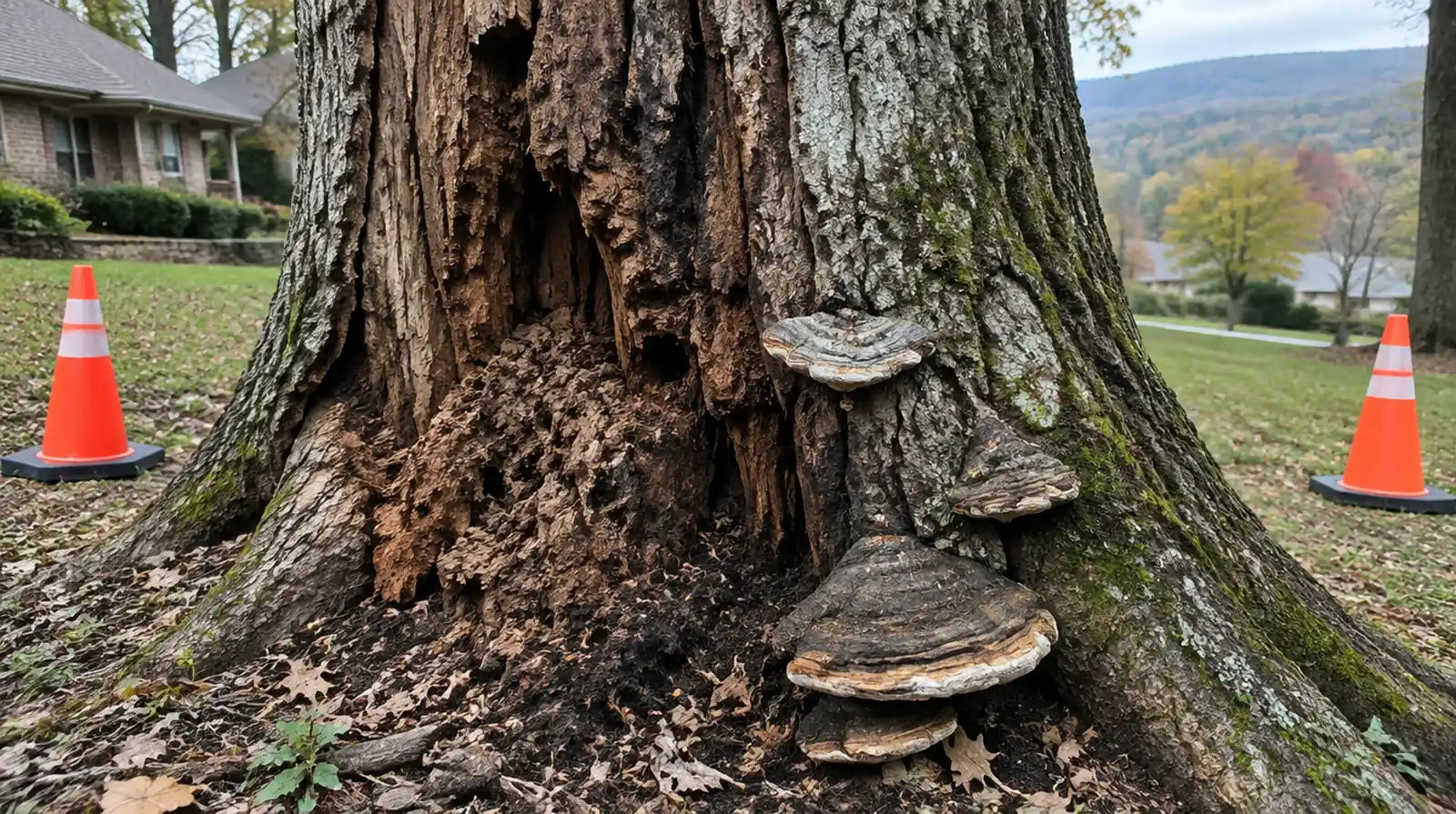
- Mushrooms, conks or other fungus growing on the trunk or root flare
- Cracks or seams running up the trunk, or bark falling off in sheets
- Cavities and soft, punky wood where limbs used to be
- A new lean, or soil cracked and raised on one side of the base
- A split between two main stems that has started to widen
- Roots cut by recent digging, trenching or construction nearby
Having one of these signs does not automatically mean the tree has to go. It means someone should look at it. If the problem can be managed with pruning or support, we will say so, and our tree health service covers that kind of assessment.
Common hazards around Fayetteville
The older neighborhoods here have a lot of large oaks that are reaching the end of their lives, and big old oaks rarely fail quietly. We also see a fair number of Bradford pears that have split apart at their crowded forks, silver maples dropping heavy limbs, and pines killed by drought or beetles standing dead at the edge of wooded lots. After a dry summer followed by a wet spring, trees with weakened roots become more likely to tip over in saturated ground.
Many of these trees stand close to houses, fences, sheds and power lines, because the neighborhoods were built around them. That combination of a weak tree and a valuable target underneath is what makes the job hazardous, and it is what we plan around.
How we take a hazardous tree down
We start by looking at the whole tree from the ground: where the decay is, where the weight is, and what is underneath. Then we pick the approach. When the tree is solid enough to climb, we tie in to a sound part of the tree, or to a neighboring tree, and lower each piece on a rope. When the tree is not safe to climb, we work from a bucket truck if the yard allows it, or take sections down with ropes and pulling lines set from the ground.
Dead wood is lowered in smaller pieces than live wood, because it can shatter under the shock of a rope catching it. The work area is kept clear of everyone who is not part of the crew, including the homeowner, until the tree is on the ground. It takes longer than a normal removal. That extra time is the safety margin.
Near power lines
If a hazardous tree is touching or could fall into a power line, the utility has to be involved before work starts. We will help you get the line disconnected or made safe. We never work a tree next to an energized line to save time. If the tree is leaning on a line right now, stay away from it and call the utility first.
Is it urgent?
A tree that has already cracked, shifted or dropped a big limb in the last few days should be treated as urgent, especially with storms in the forecast. If it is on your house or blocking access, see our emergency tree service and call right away. If it is standing but worrying you, call or send the form, and we will get out to look at it as soon as we can.
What you get
A written price before work begins, careful removal, chipping and hauling of the debris, and a raked and cleaned work area. The stump can be ground on the same visit. If you need documentation for an insurance claim, we can provide photos and an itemized invoice.
Common questions
Can I wait until spring to deal with a dead tree?
Sometimes, but dead wood gets weaker every month it stands, and winter ice and spring storms are when it is most likely to fail. If it is near the house or a spot where people walk, sooner is better.
Who is responsible if my neighbor's dead tree threatens my house?
That is a question for the neighbor, your insurer, or an attorney, not a tree crew. What we can do is look at the tree and describe its condition in writing so everyone is working from the same information.
Does a hazardous removal cost more?
Usually, yes. The extra planning, smaller pieces and slower pace add time. You will see the price in writing before we start.
Get a hazardous tree assessed
Tell us what you're dealing with and we'll get back to you with a no-obligation quote. Most estimates are free and on-site.