Tree Cabling and Bracing in Fayetteville, AR
Extra support for a tree with a weak fork or a heavy limb, so you can keep a tree you would otherwise lose.
(479) 317-8391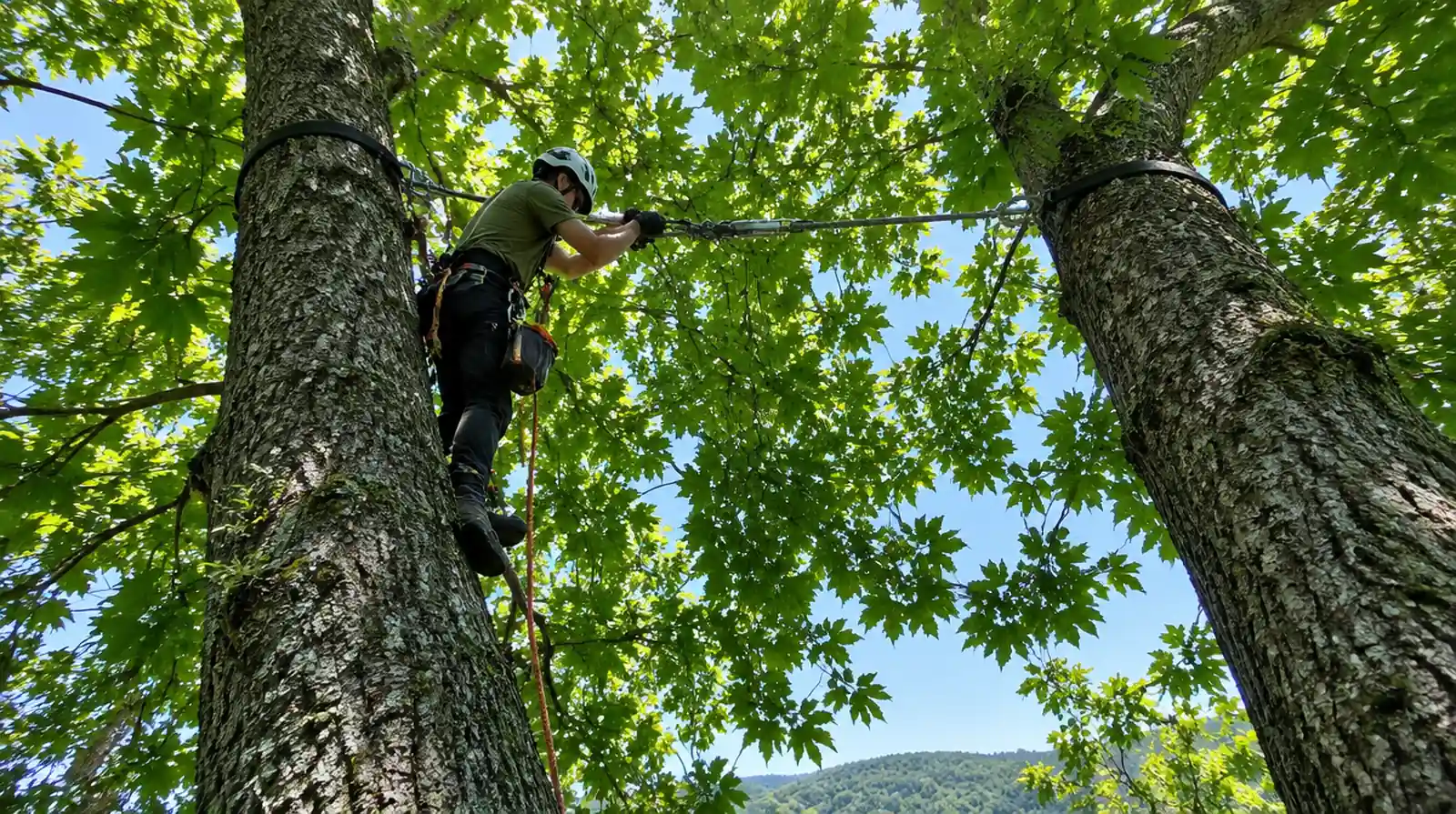
What cabling and bracing actually do
Some trees grow with two or three main stems of about equal size rising from the same point. Arborists call these co-dominant stems, and the joint between them is often weaker than it looks, especially when bark gets pinched inside the fork as the stems grow. Under the weight of ice or the push of a strong wind, that joint can tear apart. A cable installed high in the canopy limits how far the stems can move away from each other, which takes stress off the fork.
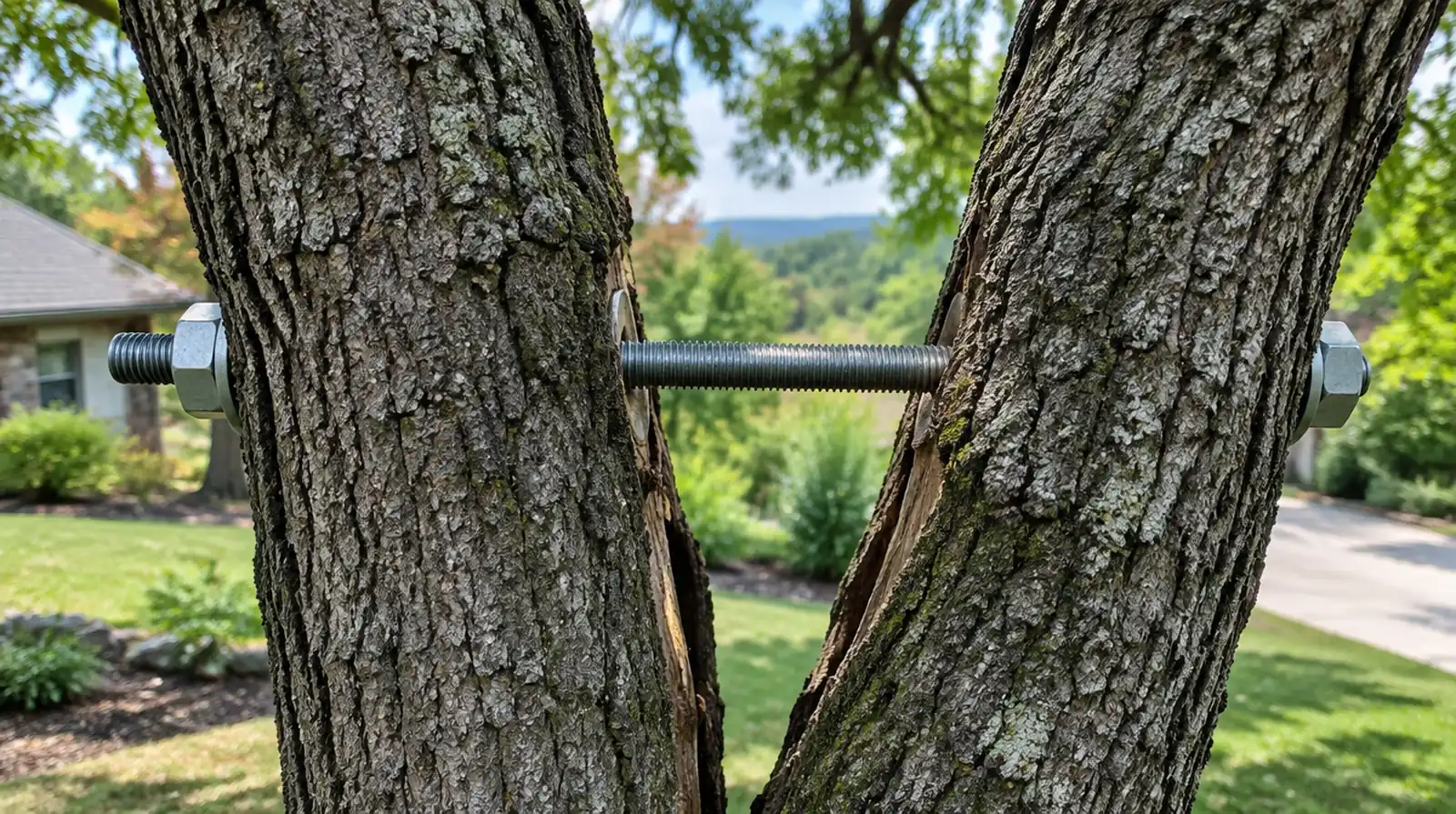
Bracing is the same idea lower down. A threaded steel rod is installed through the stems or through a crack, holding the wood together where a cable alone would not be enough. Many trees get a combination: rods near the fork and a cable higher up.
Trees that are good candidates
Cabling makes sense on a tree that is otherwise healthy and worth keeping, with a specific structural weakness that can be supported. Typical examples are a big shade tree with a V-shaped fork over the house, a mature oak with one long, heavy limb reaching over the driveway, or a tree that has started to split but where the wood is still sound.
It is not a fix for a tree that is dying, decayed through the trunk, or failing at the roots. Hardware cannot hold up a tree that has lost its strength. In those cases we will tell you plainly, and our hazardous tree removal page explains what comes next.
Why it matters in Northwest Arkansas
This part of the state gets a mix of weather that is hard on weak forks: spring thunderstorms with strong straight-line winds, and the occasional winter ice storm that loads every limb with weight it was never built to carry. Trees with weak unions are often among the first to split in those events. Supporting a tree before the storm is far less expensive and disruptive than cleaning up after a half of it lands on the roof.
How we install a support system
First, we look at the whole tree, not just the fork. We check the root flare, the trunk, the canopy and the wood around the weak point, because a support system is only as good as the wood it is anchored to. If the tree is a good candidate, we plan where each anchor goes and what hardware the tree needs.
Cables are installed about two thirds of the way from the weak fork to the tips of the stems, anchored with hardware threaded through the wood rather than wrapped around the outside of the branches. Wrapping a cable around a limb girdles it as the tree grows, so we do not do it. Brace rods go through solid wood, sized to the stems they support. The goal is support that limits dangerous movement while still letting the tree sway a little in the wind, which is what keeps the wood strong.
Pruning goes with it
Hardware works best when the load on the weak point is reduced at the same time. That usually means some careful pruning to shorten an overextended limb or thin out heavy end weight. Pruning and support together give the tree a much better chance than either one alone.
Upkeep after installation
A cabled tree is not a set-and-forget job. The tree keeps growing, hardware can loosen, and a cable that was right a few years ago may need adjustment. We recommend having the tree and hardware checked periodically and after any major storm. If a cable ever looks slack, frayed or pulled out of the wood, give us a call.
Getting an assessment
Call (479) 317-8391 or send the form with a description of the tree and what worries you. We will come out, look at it, and tell you honestly whether cabling or bracing will help. If it will, you get a written price. If it will not, you will know why.
Common questions
Will cabling hurt my tree?
Installing hardware means drilling small holes through the wood, and the tree responds to those the same way it responds to any small wound. A healthy tree seals them off. Done correctly, the benefit of supporting a weak fork far outweighs that small injury.
Can you see the cables from the ground?
Usually only if you know where to look. The cables run high in the canopy and are hidden by leaves for most of the year. In winter, with the leaves down, you may be able to spot them.
How long does a support system last?
The hardware itself can last many years, but the tree keeps growing around it. That is why periodic inspection matters. As the tree changes, the system may need to be adjusted or added to.
Is cabling a guarantee the tree will not fail?
No. It reduces the risk of a weak fork splitting, but no hardware can promise that a tree will never break in a severe storm. We will be straight with you about what it can and cannot do.
Ask about cabling a tree
Tell us what you're dealing with and we'll get back to you with a no-obligation quote. Most estimates are free and on-site.